MATERIAL NOTES / COMPARISON
Three materials. A considered choice.
Begin with what the material is. Then consider what you want it to bring to the room.
Explore the material library ↗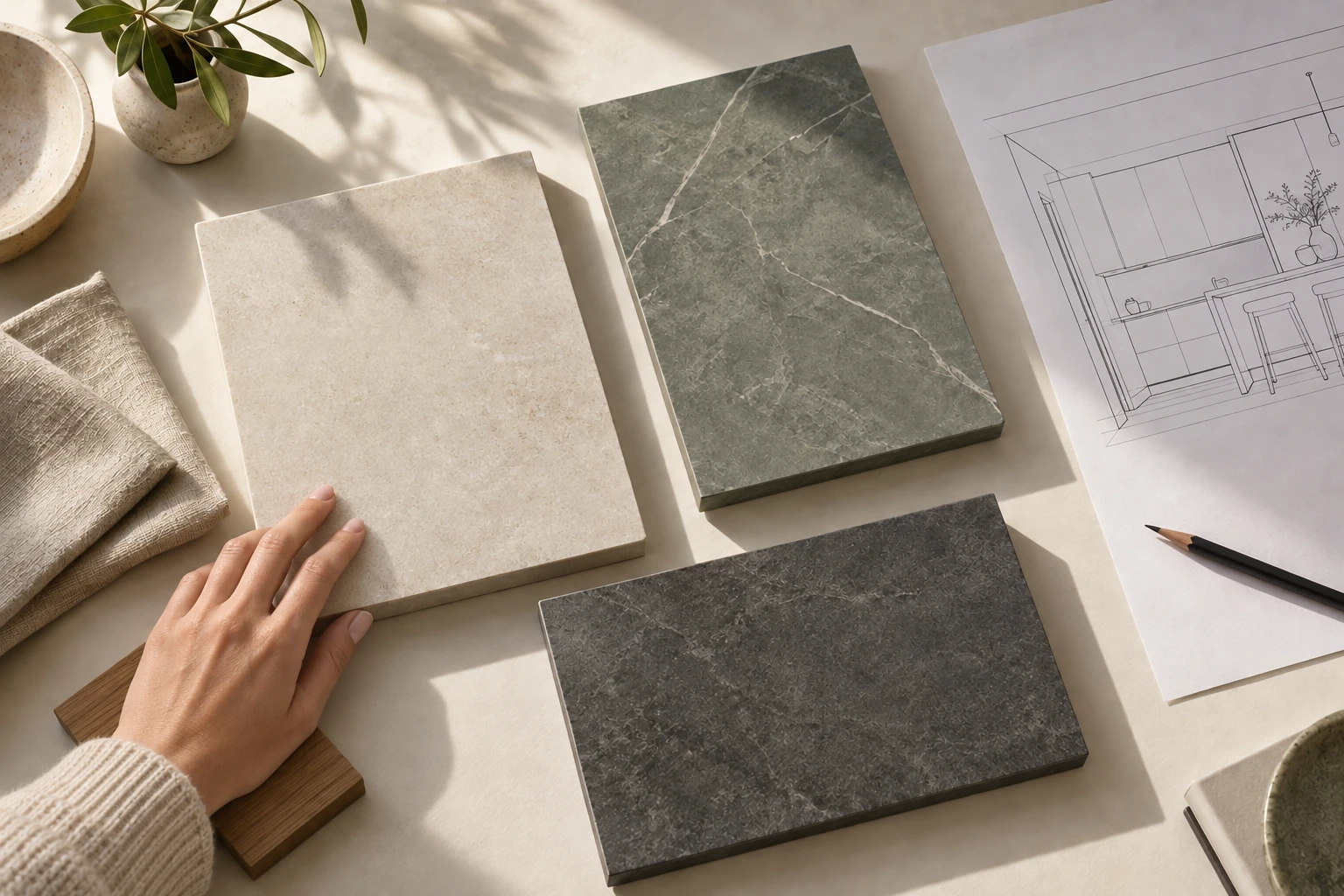
AT A GLANCE
Sintered stone is a manufactured mineral surface formed with heat and pressure; engineered quartz combines mineral content with binders; natural stone is quarried. Compare exact products and full slabs, not just category names or a photograph.
| Compare | Sintered stone | Engineered quartz | Natural stone |
|---|---|---|---|
| Material identity | Manufactured mineral surface formed with heat and pressure. | Manufactured composite; confirm the specific formulation. | Quarried stone; identify the stone type and selected slab. |
| Pattern approval | Review the complete available faces and proposed cuts. | Review the complete available faces and proposed cuts. | Review the actual slab proposed for your project. |
| Care decision | Use the selected product’s instructions. | Use the selected product’s instructions. | Confirm stone-specific care and whether sealing is appropriate. |
| Before ordering | Confirm application, thickness, support and fabrication. | Confirm application, thickness, support and fabrication. | Confirm application, thickness, treatment and fabrication. |
What is the difference between the three?
Sintered stone is manufactured using heat and pressure. Engineered quartz is a composite surface; Caesarstone describes its quartz surfaces as mineral content combined with resin binders and pigments. Natural stone is cut from quarried stone. Similar-looking marble patterns can therefore belong to different material categories. Ask for the precise product identity before comparing specifications.
Compare the full surface, not a small sample.
For each shortlisted material, review the complete slab or catalogue face at the intended scale. Ask which faces are available and whether the selection refers to a specific natural slab or a manufactured pattern. Place your wall or worktop outline over the proposed face so you can see which details remain after cutting.
Compare the edge as well as the face.
A surface photograph cannot show how a fabricated edge will look. Ask to see the proposed cut edge, built-up edge or mitred detail using the selected material. Do not assume a decorative pattern runs through the full thickness. Bring the edge, slab thickness, supporting construction and openings into the same discussion.
Does natural stone always need sealing?
There is no single rule for every natural stone. The Natural Stone Institute says many marble and granite countertops can benefit from sealing, while most granite countertops do not need it. Ask for advice on the exact stone, finish and any existing treatment. For manufactured surfaces, follow the selected manufacturer’s care instructions rather than transferring advice from another material.
Which is best for a kitchen?
There is no universal winner for every kitchen. Compare the actual product’s intended use, care guidance, technical documentation, fabrication requirements, appearance and installed cost. Claims about resistance to heat, staining or scratching need product-specific support; a category label alone is not a performance guarantee.
Bring a shortlist, not just a favourite photograph.
Choose two or three surface references and note what you like: undertone, pattern scale, finish or edge. Share your project location and dimensions with LITHMERE. We can help develop the material direction and slab composition, then prepare a quote for the agreed scope.
Sources & scope
Category background, checked 9 October 2026. Manufacturer information describes that manufacturer’s products; it does not certify LITHMERE catalogue references.
WE CAN HELP YOU DESIGN IT
From material choice
to slab layout.
We help you develop a material palette, plan vein direction and slab placement, and consider where the joints and edges belong in your space.
Explore our design support ↗Keep exploring.
What Is Sintered Stone? A Material Selection Guide
A surface begins with a material. The choice becomes personal when you consider the room, the light and the way you will use it.
Read the guide ↗APPLICATION NOTES / KITCHENSintered Stone Countertops & Kitchen Worktops
The kitchen worktop is where a drawing meets daily life. Start with the way you cook, gather and move through the room.
Read the guide ↗PROJECT NOTES / COSTSintered Stone Cost
The surface is one part of the project. A useful quote makes the rest visible.
Read the guide ↗